

Jalapeño Shows OpenAI Is Building Beyond Models
OpenAI’s first custom inference chip points to a broader contest over the complete AI system — but its early benchmark results remain company-reported.
- Date
- By
- Palantia AI Editorial Desk
- Reading time
- 7 min
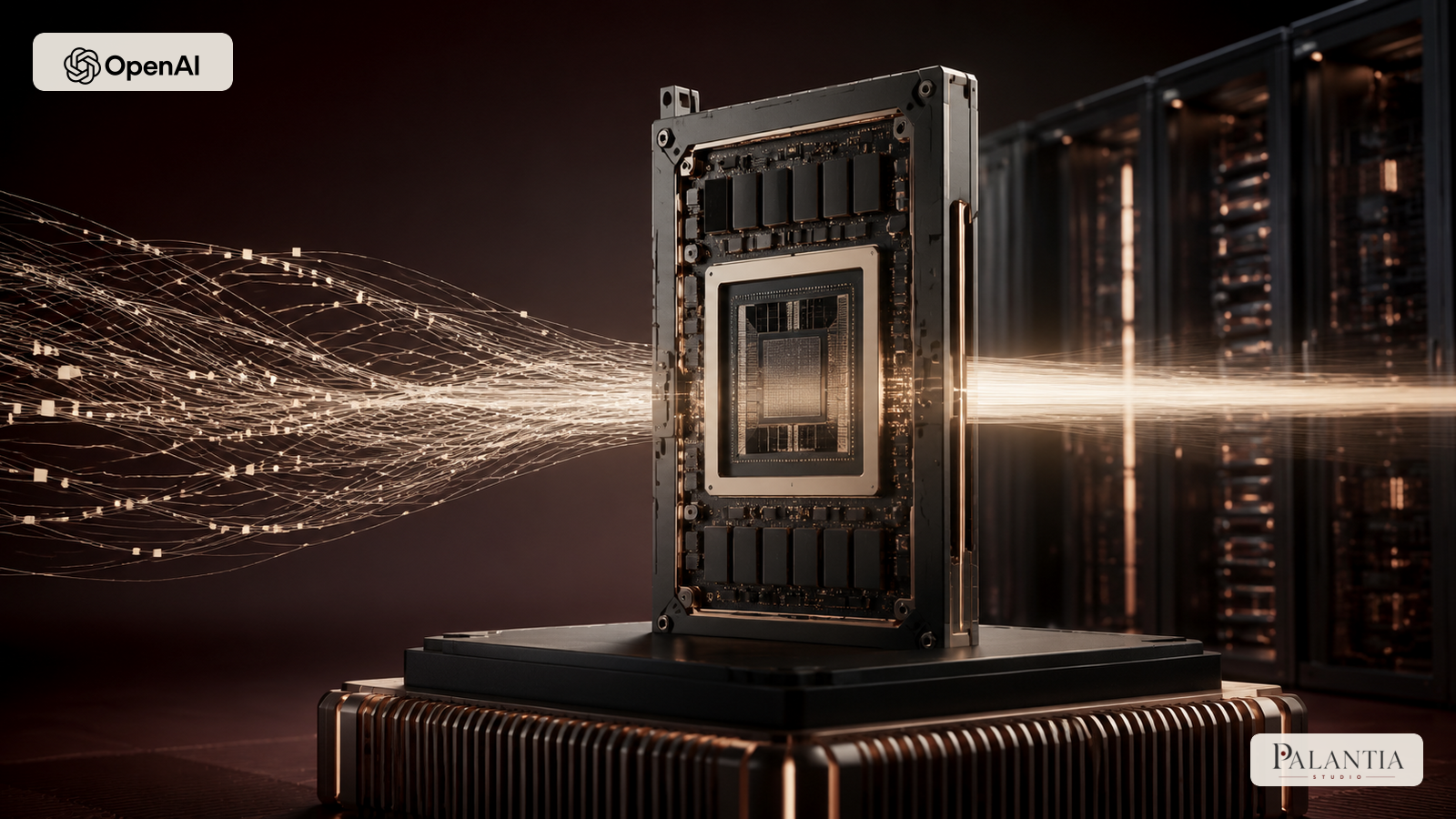
Executive summary. OpenAI says Jalapeño delivers 1.5–1.9× more AI work per watt and 1.7–3.6× lower end-to-end latency than the compared NVIDIA systems in its tests. The strategic signal is broader than the benchmark: OpenAI is developing the ability to co-design models, serving software, memory, networking and silicon. The results are promising, not independently validated production economics.
The competitive lens is changing
OpenAI’s first published results for Jalapeño shift the question from “Which model is best?” toward “Which complete system can deliver the right capability, latency, reliability and cost?” The chip does not make a model more intelligent. It changes how efficiently and responsively a model may be served under the tested conditions.
That distinction matters for leaders. Model quality wins attention, but infrastructure performance helps determine whether an AI capability becomes a dependable product, an affordable workflow or an experiment that never scales.
Palantia Take. The frontier AI race is becoming a competition between complete systems, not only between models.
What OpenAI reported
OpenAI tested Jalapeño with the public InferenceX benchmark across GPT-OSS 120B, DeepSeek R1 670B and Kimi K2.5 1T. Depending on the model, the comparison used NVIDIA GB200 or GB300 systems and examined three separate dimensions: AI work per watt, end-to-end latency and minimum time between tokens.
| Public model | Comparison system | AI work / watt | End-to-end latency | Minimum TBT |
|---|---|---|---|---|
| GPT-OSS 120B | GB200 | 1.9× | 1.7× lower | 2.7× lower |
| DeepSeek R1 670B | GB300 | 1.7× | 3.6× lower | 4.1× lower |
| Kimi K2.5 1T | GB300 | 1.5× | 3.4× lower | 3.8× lower |
Source: OpenAI, “Jalapeño’s first results”, 25 August 2026. Company-reported benchmark data; not independently replicated at production scale.
Read the methodology carefully
The ratios use published accelerator power ratings to normalise the comparison. Separately, OpenAI says Jalapeño is rated at 700 W and sustained no more than 550 W on the tested workloads. The 550 W observation should not be described as the denominator for every published efficiency ratio.
OpenAI also says it moved from initial design to tapeout in nine months, using AI across design, verification and software optimisation. That is a second company claim worth watching: AI was part of both the chip’s workload and the process used to build it.
Evidence boundary. Treat the benchmark as evidence that OpenAI has developed a credible new capability. Do not yet treat it as proof of manufacturing yield, production reliability, customer pricing or end-to-end economics.
Why full-stack control matters
Modern inference is not one calculation on one chip. A request moves through prompt processing, token generation, memory, interconnects, rack-scale systems and serving software. Improving one layer can simply expose the next bottleneck.
OpenAI’s thesis is that co-design can reduce those compromises. The potential advantage does not come from owning one component in isolation. It comes from the feedback loop between frontier workloads and every layer that serves them: models and products, serving software, accelerator design, memory and networking, and rack-level deployment.
Google TPUs, AWS Inferentia and Microsoft Maia reflect the same structural logic. OpenAI’s position is distinctive because it develops frontier models, operates a major consumer product, sells an API and now designs first-party silicon. That can create a powerful optimisation loop — and deeper capital, supply-chain and operational complexity.
What changes for enterprise leaders
The announcement is strategically useful only when translated into a completed task. Lower latency can support more natural voice interactions, shorter agent workflows or greater capacity. It creates business value only if task quality, recovery behaviour, reliability, availability and total cost also meet the threshold for the use case.
| Decision area | Measure now | Do not assume |
|---|---|---|
| Product experience | Completed-task time, successful outcomes and recovery behaviour. | Faster tokens automatically improve task quality. |
| Operating economics | Total cost per completed task, capacity and availability. | A benchmark multiple becomes customer pricing. |
| Vendor strategy | Portability, concentration risk and integration effort. | Vertical integration always reduces dependency. |
A practical response
- Baseline one meaningful workload: quality, latency, recovery behaviour, successful outcomes and total task cost.
- Run the same workflow across the options available to the organisation today.
- Define the improvement threshold that would justify switching, redesigning or adding a provider.
- Track whether Jalapeño produces customer-visible changes in latency tiers, pricing, availability or product capability.
What remains unproved
- Independent replication of the benchmark under sustained, production-like conditions.
- Manufacturing yield, supply availability and operating reliability at scale.
- Customer pricing or lower end-to-end costs attributable to Jalapeño.
- The size of any advantage on OpenAI’s own frontier models.
- The long-term balance between first-party silicon and NVIDIA or other partner accelerators.
What to watch next
- Production deployment. OpenAI plans to begin using Jalapeño in its compute infrastructure by the end of 2026; production qualification is still under way.
- Independent results. Look for InferenceX tests across more models, serving conditions and sustained workloads.
- Customer-visible economics. Watch for explicit changes in latency, price, availability or product tiers.
- Supplier balance. Track how future Jalapeño generations coexist with NVIDIA and other accelerator partners.
The larger signal
Jalapeño does not prove that OpenAI will become a leading semiconductor company. It does show that OpenAI no longer sees model development as the full competitive boundary. It is building the system beneath the model because that system increasingly determines what the model can become as a product.
Final reading. The chip is the evidence. The strategic story is OpenAI’s attempt to control more of the system beneath the model.
Sources and methodology
Primary source: OpenAI, “Jalapeño’s first results”, published 25 August 2026; consulted 1 September 2026. Context: official product information for Google Cloud TPUs, AWS Inferentia and Microsoft Azure Maia. Method: primary-source review, claim classification and strategic interpretation. No forecast, personalised investment advice, customer-pricing claim or production-performance guarantee is inferred from the announcement.
Contextual next step
Choose one latency-sensitive AI workflow and establish its operating baseline before infrastructure claims become purchasing decisions.
Source links